Why Gmail and Outlook are Silently Killing Your Business
 Hans Desjarlais
·
·
8 min read
Hans Desjarlais
·
·
8 min read
If your business sends emails, transactional or marketing, you'll want to pay attention because this directly impacts your bottom line.
What I've observed in the last 4 years isn't good and the frustration is real.
Since 2022 I’ve performed hundreds of audits and consultations for businesses wanting to stop landing in spam, and start landing in the inbox.
Most of my clients come from a checklist I launched on Hacker News 4 years ago and Upwork, where I’ve maintained a 100% job success rate and reached Top Rated status (not an easy feat to accomplish if you know Upwork).
I’m not just some guy that wrote a deliverability checklist once upon a time and considers himself an “expert”.
I don't consider myself an expert. No one is.
I'm just a guy on the bleeding edge who's been in the trenches, having conversations with hundreds of businesses about the real challenges they face.
And I can tell you, what I’m seeing isn’t good and the frustration is real!
Here’s what I’ve observed in the last 4 years:
70% of consumers use Gmail (Outlook/Hotmail/Live & Yahoo account for the rest)
95% of small businesses use Google Workspace (5% use Office 365)
Most businesses are unaware they have deliverability problems.
The landscape has changed, Google and Microsoft now control it.
ESPs built their entire business models during a time when deliverability wasn’t even an issue, and is now treated as an afterthought.
Tech fatigue is real — people are tired of constantly figuring things out.
Most deliverability tools throw a bunch of data at you and expect you to figure it out.
Most businesses can’t afford to hire a full time deliverability specialist.
The knowledge gap is real — even seasoned marketers are taken by surprise.
Deliverability isn’t something you set up once and forget, you have to monitor it constantly.
You can do everything right but if you make one mistake, you can still lose.
Let me start with the biggest shift, because it explains almost everything else.
The Duopoly: A Silent Tax on Your Business
When I started my career in tech, most businesses ran their own mail server on a cPanel account, with an open-source spam filter called SpamAssassin doing the filtering. That world is gone.
On the consumer side, Gmail launched in 2004 and gradually took over.
By 2015 it had overtaken Hotmail as the most popular US email provider, and today roughly three-quarters of US adults aged 18–64 use it.
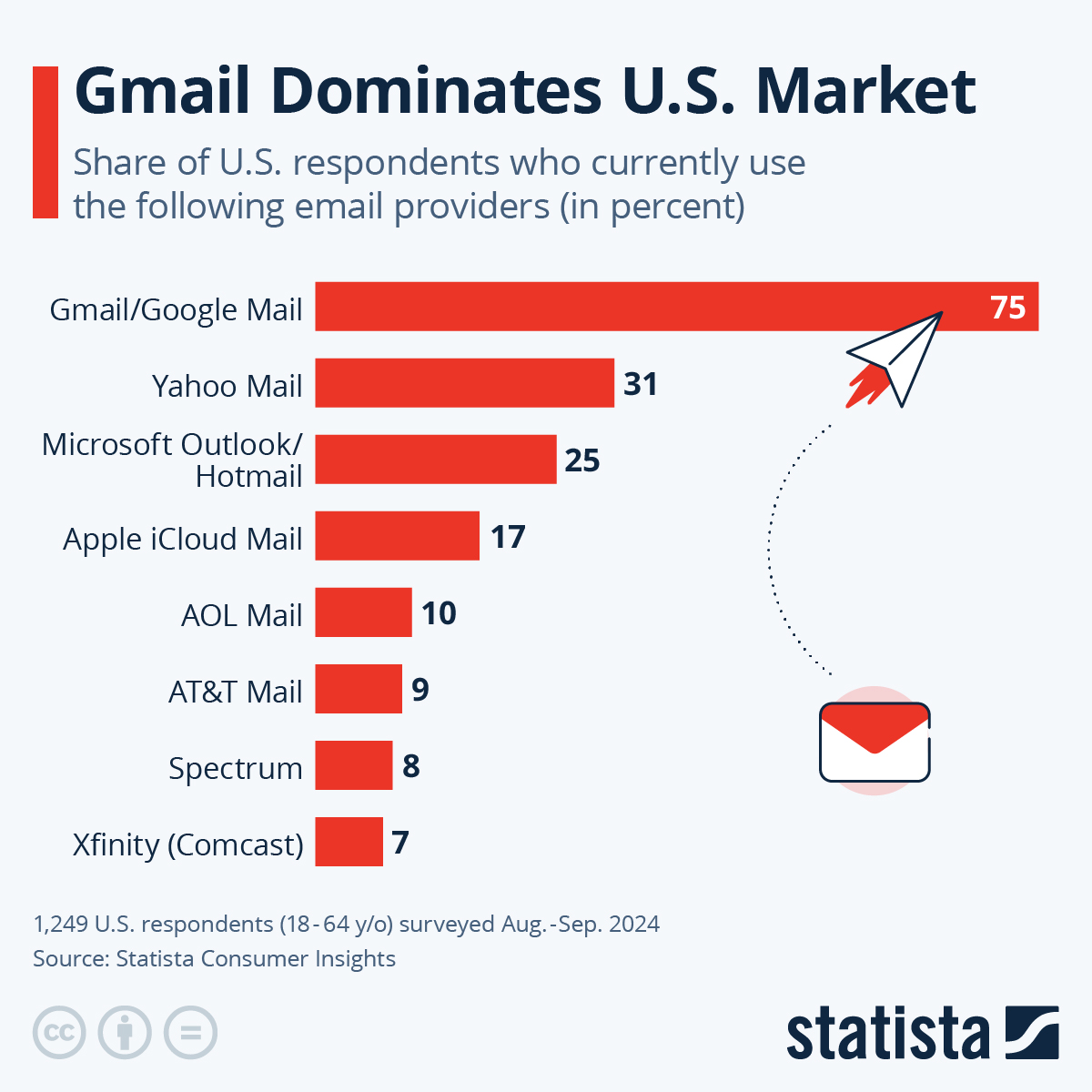
Source: https://www.statista.com/chart/34197/share-of-us-respondents-use-email-providers/
The business market consolidated along the same lines, just a few years behind.
Google launched G Suite (now Google Workspace) in 2006.
Microsoft responded with Office 365 in 2011.
Today those two products account for roughly 95% of the business productivity software market — Google owns SMB and education, Microsoft owns the enterprise.
Two companies now sit between your business and every email it sends.
Spam filtering tells the same story.
Gmail, Outlook, and Yahoo all run proprietary systems that analyze thousands of signals — engagement history, sender reputation, authentication alignment, complaint rates.
In February 2024 this got a lot more concrete.
Google and Yahoo rolled out new requirements for senders pushing more than 5,000 emails per day: SPF, DKIM, and DMARC became mandatory, one-click unsubscribe was required, and spam complaint rates had to stay below 0.10% in Postmaster Tools.
Cross 0.30% and your mail gets rejected outright.
From November 2025, Gmail tightened enforcement further.
That's what makes this a tax rather than a fee.
Google and Microsoft don't just host your inbox and your customers' inboxes — they now decide which of your emails reach them.
Get on their wrong side and your sales pipeline can go dark overnight.
The cost isn't the per-seat licensing line on your invoice.
It's the dependence on two companies whose deliverability rules you have to learn, follow, and re-learn every time they change them.
And from the hundreds of conversations I've had with clients, most businesses don't have the bandwidth to monitor this consistently.
Your Email Service Provider Isn’t Built to Help You
Here's a scenario I see play out with my clients all the time:
Client: "How can we improve our open rate?"
ESP: "Here's a link to our deliverability documentation."
Client: "Okay, it says we need to generate engagement. But how do we generate engagement if our emails are going to spam?"
ESP: "…you need to generate engagement."
Client: "???"
I call this the Catch-22 of modern email.
Businesses get caught off guard by the changing landscape and the duopoly's latest rule changes, and suddenly they're stuck.
How do you generate engagement if your subscribers never see your emails?
I recently audited an EdTech company in Los Angeles.
They send regular informational emails to educators across the US.
Nothing promotional. Purely informational.
They've been in business for almost two decades.
They did everything right: SPF, DKIM, DMARC, opt-in subscribers, quality informational content, sent regularly.
Then a few months ago they sent an important update after a six-month hiatus.
Open rate: less than 10%.
The audit revealed their domain reputation in Google Postmaster Tools had dropped to Bad.
Every one of their emails was landing in Gmail's spam folder. Their most important mail provider.
Cue the confusion and frustration. Understandably.
And this isn't an uncommon scenario.
I've seen this exact problem repeated across many clients.
Now think of the billions in email-driven revenue and opportunities lost by businesses every year to Google and Microsoft’s spam filters.
Boggles the mind.
So why does this keep happening?
Because your ESP isn't built to help you.
Look at how they charge you.
Nearly every ESP prices by the number of contacts on your list.
Now look at one important lever for fixing deliverability — purge your unengaged subscribers.
That cohort of un-engaged contacts sitting in your account?
They're a big part of the reason Gmail is sending you to spam.
Cutting them is the single most effective thing you can do.
But cutting them shrinks your ESP's revenue.
Their pricing model is in direct conflict with your deliverability.
You can't expect a company to talk you into a smaller invoice.
It gets worse.
The major ESPs built their businesses 10–15 years ago, when deliverability barely existed as a discipline.
Their products were designed for one job — sending a lot of email, fast.
Deliverability was bolted on later as a help-center article.
It was never the core product, and it still isn't.
Then there's what they actually control: the only deliverability lever an ESP genuinely owns is the reputation of the shared IP pools you send through.
And that reputation is determined by how their customers send — bounce rates, spam complaints, list hygiene.
Your fate is decided by the worst-behaved senders in your pool, and the ESP is powerless to police them without triggering churn.
So they push the responsibility back onto you. "Generate engagement." "Improve your sending practices." "Here's a documentation link."
This is why their support is so bad.
It's not because the agents are dumb.
It's because there's no actual product to point you at.
Their deliverability team is a cost center keeping the platform's IP pools alive — not a service designed to make you successful.
You walk away from the ticket more confused than when you opened it, because the answer to your question doesn't exist on the platform you're paying for.
Think of the millions of businesses in the US alone who are sending into the void, unaware of what they're doing wrong.
They're just doing what worked for decades.
The Knowledge Gap is Real
Many of my clients used a tool to test deliverability at some point. Think GlockApps or Folderly.
They turned to an email deliverability specialist, not because they didn’t have enough data, but because they didn’t know how to interpret and apply the data.
Those tools just throw a bunch of data at you, and expect you to figure it out.
They’re frustrated and tired, they just want someone competent to tell them what to do.
I typically charge $200 an hour for a consultation or $2500 for full deliverability audit which is very reasonable compared to the competition.
And businesses are happy to pay because it solves a hyper critical problem.
But deliverability isn’t a one-time thing, you need to monitor it constantly.
My clients are business owners and marketing directors, they’re already super busy, the last thing they need is another level of complexity draining their time and resources.
And that’s exactly why I built Hello Inbox.
Because I kept seeing the same deliverability problems over and over.
Now, the tools I built and the AI assistant I trained can help thousands of people at once—with the same expertise I bring to my consulting clients.
We Take the Pain Away
Hello Inbox is everything I've learned in 4 years of audits and consultations, distilled into one platform any marketer can use — without needing to book an expensive consultation or deliverability audit.
At the core is an AI assistant I trained on the same playbook I use with my consulting clients.
Ask it why your open rate dropped, what your DMARC report actually means, or how to recover a damaged reputation, and you get a clear, step-by-step answer.
Not a documentation link. Not a wall of data. The exact next step, in plain language.
Around the assistant, I built 9 tools that handle the work businesses would normally outsource to me — deliverability tests, DMARC monitoring, list verification, inbox placement tests across Gmail, Outlook, and Yahoo, spam word checks, a warmup toolkit, and continuous monitoring that alerts you the moment your reputation starts slipping.
Every tool feeds back into the AI, so when it gives you advice, it's grounded in your actual setup — your authentication, your Google Postmaster Tools data, your ESP analytics.
Specific to you, not generic.
Because here's the thing — deliverability isn't a one-time fix.
The duopoly will change the rules again.
Your reputation will dip when you least expect it.
Someone on your team will send the wrong campaign to the wrong list.
With Hello Inbox, you'll catch it before your open rate tells the story — and you'll have a deliverability expert in your pocket telling you exactly what to do about it.
